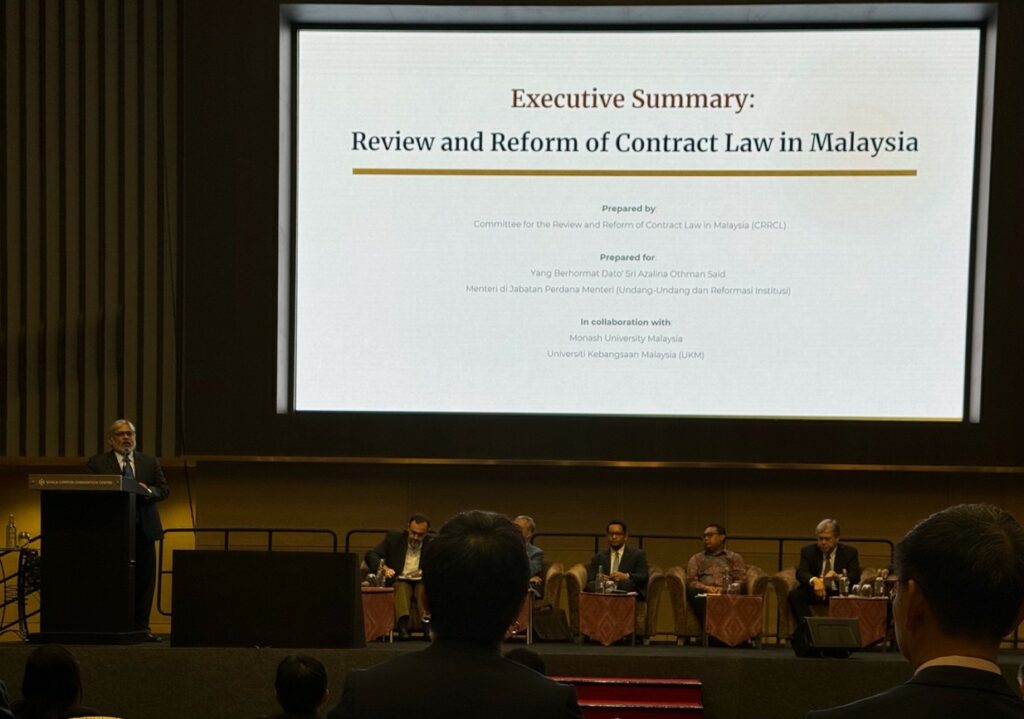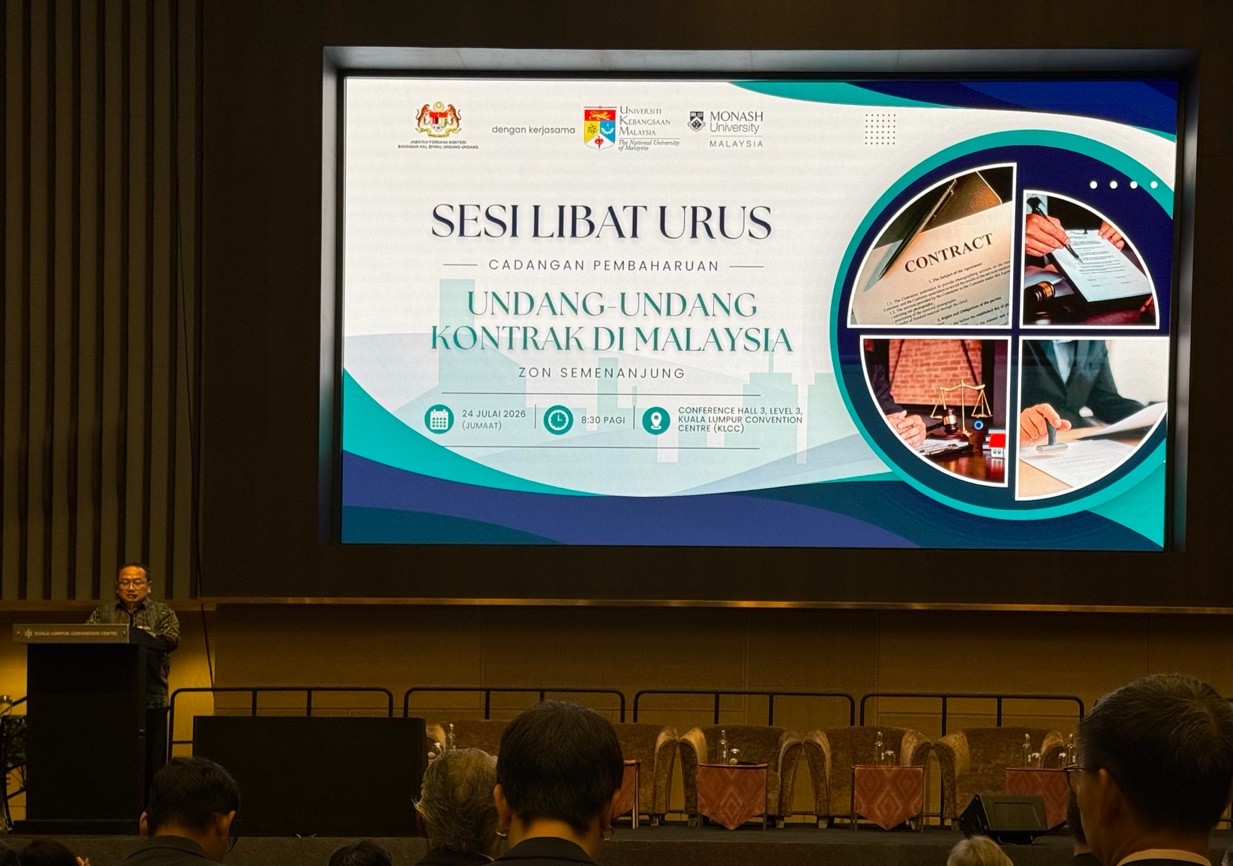
On 24 July 2026, the Association was invited to attend an engagement session on the proposed review and reform of contract law in Malaysia. During the session, the Committee for the Review and Reform of Contract Law in Malaysia (CRRCL) presented its findings and recommendations for reforming the Contracts Act 1950 (Act 136).
This note summarises the key proposals presented by the Committee for the Review and Reform of Contract Law in Malaysia and highlights preliminary points that may be relevant to engineering consultancy practice. It is intended to help members understand the possible professional implications of the proposed reforms while the Association continues to monitor developments.
The Contracts Act has remained largely unchanged since it came into effect 75 years ago. It was itself based on the Indian Contract Act 1872, which was established during British colonial rule in India.
The four main rationales for the reform are:
- Modernise Archaic Law: The 1950 Act is rooted in 1872 principles. It lacks provisions for modern concepts such as Artificial Intelligence (AI), digital automation, and complex e-commerce ecosystems.
- Close Judicial Gaps: Ensuring statutory law aligns with modern Common Law principles to reduce ambiguities and the need for costly litigation.
- Fairness & Protection: Addressing the lack of robust controls over unfair contract terms and “fine print” in broad commercial contexts.
- Regional Alignment: Synchronising Malaysia’s legal standards with those of Singapore, the United Kingdom, and Australia to bolster investor confidence.
Some of the major changes proposed by the Committee are:
- Introduction of new Part XI, the “Reasonableness Test” which are new controls over exclusion and limitation clauses in the “fine print” of contracts. This is a guidance for the courts (or judiciary) to assess if a smaller party is essentially being bullied into accepting unfavourable or one-sided term under duress.
- To introduce a new Agency Bill for a modern, comprehensive framework to replace Part X, covering digital agents and complex commercial representation.
- To introduce a new Third Party Rights Bill enabling beneficiaries to enforce contracts intended for their benefit, modernising the “privity” rule
The following observations on the potential impact of the reforms on engineering consultancy practice are based on the writer’s preliminary understanding of the proposed reforms.
Introduction of the definition of “warranty”
Section 21 reforms include a definition of “warranty”. The intention is to ensure that, where a party has assumed responsibility for a fact, the matter is governed by principles of contractual allocation of risk rather than mistake. Potentially, this may provide better protection for an ECP where the design is based on an agreed event, such as an Average Recurrence Interval (ARI), rather than classifying any design failure as a mistake by the ECP.
Defective contracts formed using artificial intelligence may still be enforceable
The proposal for an Agency Bill was based on the Committee’s view that, through legislative intervention, an artificial intelligence (AI) system may be capable of acting as an agent on behalf of contracting parties. In essence, if a contract, or in the writer’s view documents produced by contracting parties, was drafted by or with the assistance of AI, the terms produced by the AI may still bind the contracting parties. In other words, “AI did it, not me” is unlikely to be an acceptable basis for voiding part or all of a contract. However, the writer notes the specific statement in the report that “liability could be ascribed differently where the artificial intelligence system acted in a defective way.” In practical terms, an official publication confirming a defect in an AI system during its period of use may be one possible argument against unintentionally defective or one-sided contract clauses developed using AI.
Third parties may be able to enforce contract terms that benefit them
In current practice, the right to enforce the terms of a contract generally lies with its signatories. The proposed Third Party Rights Bill would allow an external party to enforce a term of the contract if that term purports to confer a benefit on the third party. A practical example is property development: a developer (Party A) engages a contractor (Party B) to build houses for purchasers (third parties). If purchasers discover defects during construction or upon acceptance of the houses, they may be able to take action directly against the contractor. For an ECP, this could create a risk of direct legal action from members of the public, given that engineering design is often intended to support public safety and welfare. One possible mitigation would be to state expressly that any output produced by the ECP is intended only for the use of the stated parties and not for reliance by any third party. Further review is required to understand the full impact of the proposed Bill and the appropriate form of mitigation.
Overall, the proposed reform appears to be intended to provide a more modern and fairer contractual framework for all parties. The Association will continue to monitor the progress of these proposals and, if necessary, engage legal experts to understand their potential impact on engineering consultancy practice.