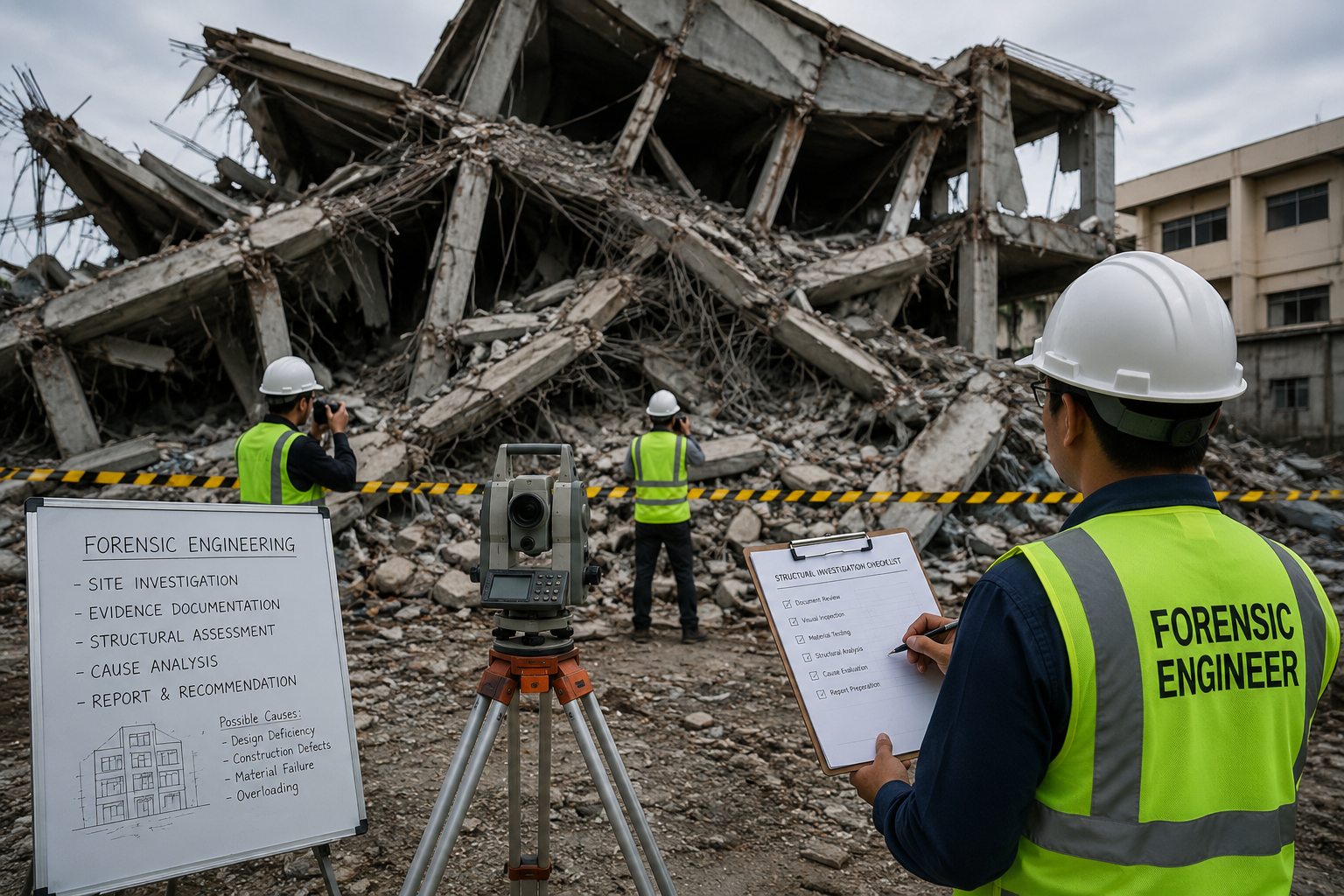
Project management has traditionally focused on delivering projects within the constraints of scope, time, cost, quality, risk and stakeholder expectations. However, the increasing complexity of infrastructure and construction projects has elevated another discipline into strategic importance, namely forensic engineering. Rather than viewing forensic engineering as an activity that begins only after a catastrophic failure, modern project management should embrace it as a proactive management tool that strengthens governance, improves risk management and enhances long-term asset performance.
Forensic engineering is the application of engineering principles and scientific investigation to determine the causes of failures or deficiencies in structures, materials and engineering systems. The discipline is not merely about identifying what went wrong but more importantly about learning from failures so that similar incidents can be prevented in future projects. This philosophy aligns closely with the objectives of professional project management. Every project manager is responsible not only for delivering a successful project but also for ensuring that the completed asset remains safe, reliable and sustainable throughout its operational life. When viewed from this perspective, forensic engineering becomes a natural extension of project quality management, risk management and continuous improvement.
Many project failures are not caused by a single technical error. Instead, they often result from a combination of inadequate planning, design deficiencies, poor communication, construction deviations, insufficient supervision, material defects, environmental influences and ineffective maintenance planning. These interconnected factors mirror the lessons learned from numerous project management case studies worldwide where organisational and technical shortcomings combine to produce costly failures. Forensic engineering systematically investigates these contributing factors to establish root causes based on scientific evidence rather than assumptions.
Integrating forensic engineering into routine infrastructure monitoring instead of relying solely on reactive investigations after failures occur provides substantial long-term benefits. Proactive forensic assessments can significantly reduce maintenance costs, extend infrastructure service life and improve public safety. This proactive approach is directly relevant to project managers who increasingly adopt predictive risk management, digital monitoring technologies and asset management principles to minimise lifecycle risks.
The emergence of Building Information Modelling (BIM), structural health monitoring systems, unmanned aerial vehicles (UAVs), sensors and digital twins has significantly enhanced forensic engineering capabilities. Modern forensic investigations no longer depend solely on visual inspections after an incident. Instead, engineers can analyse historical performance data, construction records, sensor information and digital models to reconstruct the sequence of events leading to failure. These technologies also support project managers in making evidence-based decisions throughout project delivery and asset operation.
Another important contribution of forensic engineering is dispute resolution. Construction projects frequently involve contractual disagreements concerning delays, defects, design responsibility and workmanship. Scientific forensic investigations provide objective technical evidence that supports fair decision-making during mediation, adjudication, arbitration or litigation. For certified project managers, understanding forensic methodologies enables more accurate documentation, improved record management and stronger contractual administration throughout the project lifecycle.
Forensic engineering also reinforces organisational learning. Every completed investigation represents valuable knowledge that should be incorporated into future project planning, engineering standards, procurement strategies and professional training. Lessons learned should not remain confined within technical reports but should become part of institutional knowledge that continuously improves project delivery performance.
As the nation continues investing in major infrastructure, transportation, water supply, energy and urban development projects, the integration of forensic engineering into project governance becomes increasingly important. Project managers, consultants, contractors, owners and regulators all share responsibility for ensuring that infrastructure performs safely throughout its intended design life. This requires stronger collaboration between engineering professionals, project managers and forensic specialists from the earliest project stages.
Professional bodies have an important opportunity to promote this multidisciplinary approach by encouraging development in forensic engineering awareness, risk-based decision-making and evidence-based project governance. By strengthening collaboration between project management and forensic engineering, the profession can move beyond simply delivering projects on time and within budget towards delivering infrastructure that is safe, resilient, sustainable and capable of serving future generations.
Ultimately, forensic engineering reminds every project professional that every failure contains valuable lessons. When these lessons are systematically investigated, documented and integrated into future practice, project management evolves from managing individual projects to continuously improving the engineering profession itself. The true value of forensic engineering lies not only in explaining past failures but in preventing future ones through better planning, stronger governance and continuous technical learning.
Prepared by:
Datuk Ir. Ts. Gs. Br. PMr. QPr. Dr. Amarjit Singh